
Why Do So Many Western Companies Fail in Japan,Even When Their Product Is Strong?

For more than two decades, foreign brands have tried to enter Japan—a market admired for its purchasing power, product loyalty, and long-term partnership value. Many arrive with superior products, proven traction in Europe or the U.S., and seasoned international leadership teams. And yet, most still fail.
Not because Japan is “traditional.” Not because consumers are “conservative.” And not because the market is “too slow.” They fail because they misread the system.
Japan operates on a business logic that is structurally different from Western markets—an invisible operating system built around risk elimination, collective intelligence, and long-term trust. When foreign leaders try to apply Western negotiation styles, Western decision-making speed, or Western leadership behaviors, the result is predictable:
stalled distribution conversations
“mysterious” silence after great meetings
internal pushback they never see
fragmented relationships with potential partners
deals that almost close… but never quite do
1|Why Is the Real Decision Made Before You Enter the Room?
Understanding Nemawashi , the Heart of Japanese Decision-Making
In the West, high-stakes meetings are where ideas compete, options are debated, and decisions are made. In Japan, the meeting is not the battlefield; it is the final ceremony.
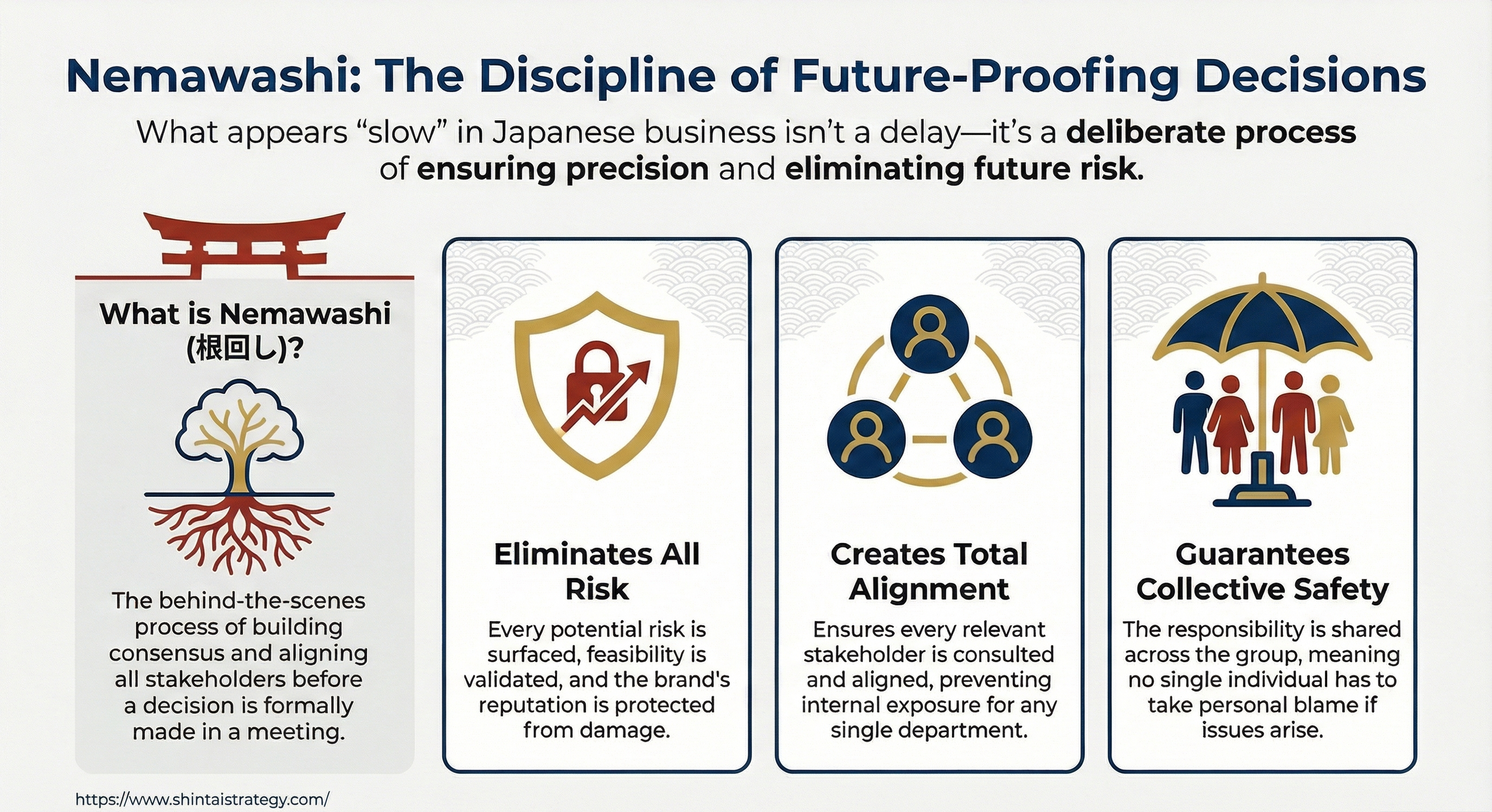
The real decision, the true strategic commitment , happens during Nemawashi(根回し ,ねまわし) a behind-the-scenes process of consensus building long before anyone steps into a boardroom.
Nemawashi is not bureaucracy. It is a discipline of future-proofing a decision.
It ensures that:
no department is exposed
all risks have been surfaced
execution feasibility is fully validated
brand reputation cannot be damaged
every relevant stakeholder is aligned
no individual must take personal blame
This is why Japanese organizations appear “slow.” They aren’t slow—they are precise.
Foreign executives often misread silence or delays as disinterest. In reality, the Japanese side is:
validating your value proposition internally
translating your claims into local expectations
conducting risk mapping
aligning technical, legal, marketing, and finance
ensuring long-term stability
Once consensus is reached, execution becomes faster and more coordinated than in most Western markets. But until then, forcing a decision is one of the fastest ways to lose trust. Japanese Decision-Making rewards patience, transparency, and technical clarity, but not pressure.
2|Why Is the Most Talkative Person Almost Never the Decision-Maker?
The Hidden Hierarchy Foreign Leaders Misread in Japanese Corporate Culture
A mistake Western teams repeatedly make—across B2B meetings, distributor negotiations, and operational reviews—is assuming:
“The person who speaks English or talks the most must be the key stakeholder.”
In Japan, it is almost always the opposite.
The person who speaks English or answers questions fluently is typically:
the coordinator
the interpreter of context
the facilitator
the processor of group input
They are almost never the final approver. Instead, decision authority usually rests with:
the quiet senior executive
the one who speaks the least
the one observing the most
the one whose facial expression barely moves
This structure exists because Japanese companies follow a collective responsibility model—where no individual answers on behalf of the group without prior internal alignment.
You will also see behaviors that puzzle Western teams:
long CC lists
multiple departments joining early meetings
answers delayed until internal consolidation
cautious verbal responses
silence used as a neutral processing space
Western leadership often interprets this as inefficiency or reluctance. In reality, it is organizational safety, a fundamental part of Japanese Business Culture.
Understanding who actually holds influence—and how decisions are socially processed , is part of mastering Japan Market Strategy, Cross-Cultural Leadership, and Japanese Negotiation Style.

3|Why Do Western Leadership Styles Fail—Even for High-Performing Executives?
Kiku (聴く,きく): The Japanese Leadership Principle Western Managers Rarely Practice
Western leadership rewards clarity, decisiveness, and strong personal ownership.
Japanese leadership rewards humility、listening、alignment、emotional intelligence、and shared credit.
This difference is not cosmetic—it is operational.
Japanese teams follow leaders who:
listen deeply before asserting
seek understanding before direction
read what is not being said
create emotional and interpersonal safety
avoid embarrassing or cornering anyone
share success, distribute credit, and minimize blame
The Japanese concept of kiku(聴く) means:
Listening with the head, the heart, and the heart’s intention , not just listening to respond.
This cultural expectation makes Western directness counterproductive.
Yes/no questions fail because:
they pressure the listener
they invite relational risk
they force premature alignment
the safest response becomes “yes” even when the real answer is “no”
High-performing foreign leaders in Japan learn to shift from:
“Tell me the answer” to “Walk me through your perspective.”
“Do you agree?” to “What concerns should we solve together?”
“Here is the plan” to “How do we adapt this for our market?”
In Japan, leadership is earned through empathy, not asserted through authority.
Conclusion|Why Do Western Companies Struggle—And How Do the Successful Ones Break Through?
Japan is not difficult. Japan is structured.
The companies that succeed understand:
decisions happen before the meeting
alignment outranks speed
silence is a form of analysis
the group carries responsibility, not the individual
listening is a strategic skill
humility accelerates trust
pressure destroys deals
patience wins multi-year partnerships
Japan rewards brands and leaders who take the time to understand its system. Not because Japan resists change, but because Japan protects relationships, quality, and long-term stability above all else.
Foreign companies who embrace this reality move from:
“trying to enter Japan” to being trusted inside Japan.
In a world obsessed with speed, Japan asks a harder but more rewarding question:
Are you willing to slow down early—so you can go much farther later?