
Japan E-Commerce 2026:A Market Misunderstood, and a Rare Strategic Window

The Market Entering 2026: Not Saturated, but Structurally Under-Digitized
Japan is often perceived as a mature and highly competitive e-commerce market. The reality is more nuanced, and far more interesting.
E-commerce penetration in Japan remains noticeably lower than in other major economies. Despite strong consumer spending power and a highly connected society, a significant portion of retail activity still occurs offline. This gap between digital potential and current adoption is what defines Japan’s 2026 opportunity space.
The market is not constrained by lack of demand — rather, it is shaped by legacy retail behaviors, slow B2B digitalization, and conservative industry structures that are only now shifting. For new entrants, this presents a moment where consumer habits are changing faster than incumbent capabilities.
2026 marks the transition from a traditional retail economy to a multi-channel digital ecosystem. This is the moment when early movers can still shape their long-term positioning.
A New Generation of Japanese Consumer Behavior
The Japanese customer remains highly discerning, but the way they discover, evaluate, and purchase products has fundamentally changed:
Younger consumers gravitate toward platforms known for speed and efficiency.
Older consumers still prefer familiar ecosystems with strong loyalty programs.
Mobile commerce has become the default, driven by convenience and habit.
Product discovery increasingly begins through content — video, livestreams, influencers, and social recommendations.
Expectations for product presentation, packaging, customer support, and after-sales care are higher than in most global markets.
A recurring dynamic is the multi-platform evaluation journey: consumers rarely rely on a single marketplace; instead, they compare prices, check reviews across platforms, verify brand trust signals, and often view third-party content before purchasing.
For brands, this means visibility must be orchestrated across several touchpoints, not concentrated in one place.
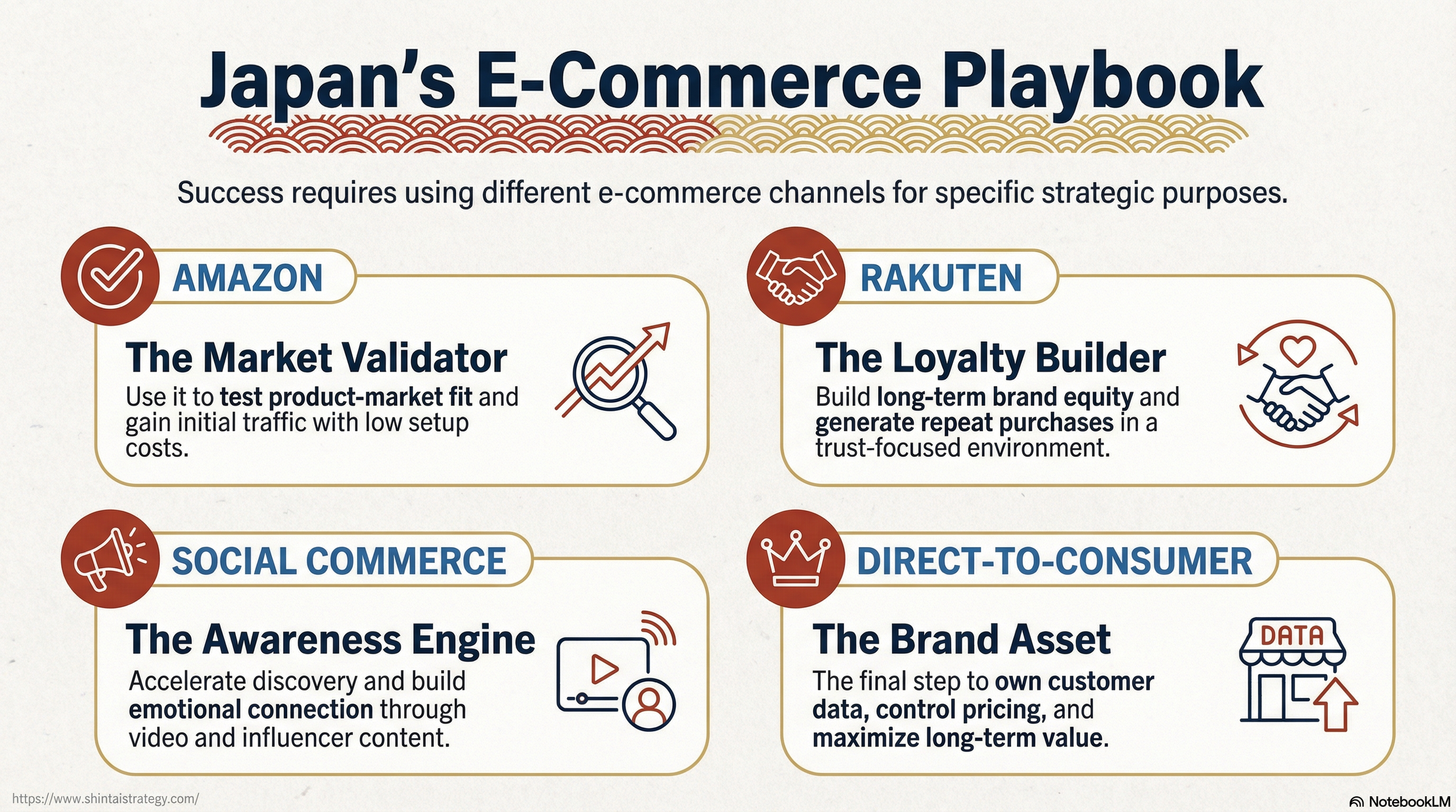
The 2026 Platform Landscape: How Each Channel Actually Functions
Japan’s market is not dominated by a single platform. It is a layered system in which each channel serves a distinct role in the consumer journey.
Amazon Japan — The Traffic Engine and Market Validator
Amazon remains the country’s most powerful discovery and comparison engine. It is where consumers search first, especially younger and mobile-centric demographics.
Strategic value:
Fastest way to test product-market fit
Low initial setup cost
Immediate access to nationwide fulfillment infrastructure
Transparent competitive benchmarks through reviews and pricing visibility
Strategic risks:
High price sensitivity
Intense competition
Strict operational and compliance expectations
Amazon is a launchpad — not necessarily the final destination — for serious long-term brand plays.
Rakuten Ichiba — The Trust-Building and Loyalty-Generating Channel
Rakuten functions more like a digital department store than a pure marketplace. Its customer base values brand reliability, detailed product information, and the ecosystem’s loyalty incentives.
Strategic value:
High repeat-purchase potential
Strong customer loyalty infrastructure
Rich brand-building environment with customizable storefronts
Ability to justify premium positioning through storytelling and service quality
Strategic risks:
Higher fixed costs
Requires strong Japanese-language operations, customer support, and merchandising
Poor execution can quickly erode margins
Rakuten excels when a brand sees Japan as a long-term market and is invested in building equity, not just volume.
Supplementary Platforms (Yahoo Shopping, Qoo10, etc.)
Not primary brand-building vehicles, but effective for:
Price-sensitive segments
Promotional bursts
Clearance and liquidation
Expanding reach without diluting premium positioning on major channels
These platforms contribute breadth, not depth.
Emerging Content-Driven Commerce (TikTok Shop, YouTube Shopping, Social Platforms)
The newest accelerator in Japan’s e-commerce landscape comes from video-based and influencer-driven commerce.
Short-form discovery and livestream-based selling resonate strongly with younger consumers and with products that benefit from demonstration, narrative, or entertainment.
Strategic value:
High conversion when paired with credible creators
Builds emotional affinity and trust faster than static product pages
Ideal for accelerating early-stage brand awareness
Strategic risks:
Requires operational readiness for real-time demand spikes
Demands high-quality content, coordination, and community engagement
Direct-to-Consumer Sites — The Long-Term Brand Asset
A brand-owned e-commerce site becomes essential once:
Brand awareness is established
Direct customer relationships and data become priority
Price control and margin protection matter
A loyalty and membership strategy is feasible
DTC is not the first step into Japan — it is the structural foundation for long-term presence, anchored by the trust earned through marketplace success.
What Will Define Winners in Japan 2026–2028
Japan’s next phase of e-commerce growth will not reward brands that simply list products. It will reward brands capable of delivering quality, narrative, and consistency.
The determining factors will include:
Operational excellence: logistics discipline, packaging integrity, and responsive customer service
Experience design: clarity of product detail, thoughtful mobile UX, and frictionless checkout
Content fluency: storytelling that explains, demonstrates, and contextualizes the offering
Localization maturity: language quality, cultural adaptation, regulatory compliance
Cross-channel coherence: unified presence across marketplaces, social channels, and owned platforms
The brands that treat Japan as a system, not a set of isolated channels, will outperform.
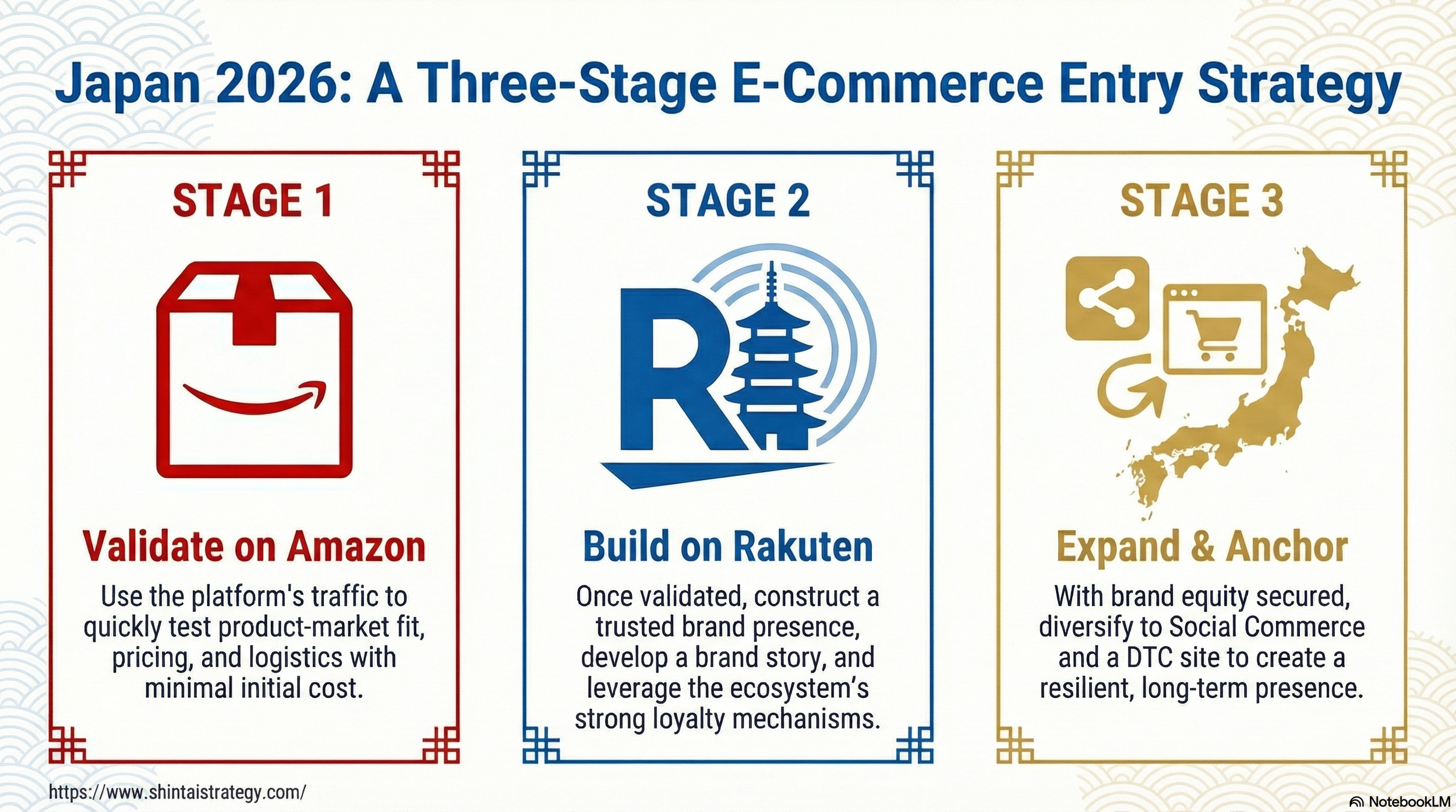
A Three-Stage Market Entry Strategy for 2026
Stage 1 — Validate
Begin with Amazon.
The platform reveals quickly whether the product resonates, what objections consumers raise, and how competitive the landscape is.
Key goals:
Identify fit
Test pricing
Assess logistics requirements
Build early reviews and credibility
Stage 2 — Build
Once initial traction is proven, shift to Rakuten to construct a brand presence that consumers can trust and revisit.
Key goals:
Develop a comprehensive brand story
Expand SKU breadth
Implement localized customer support
Leverage the ecosystem’s loyalty mechanisms
This stage is where a brand “arrives” in Japan.
Stage 3 — Expand and Anchor
With brand equity secured, the final step is to diversify channels and reinforce long-term value creation.
Actions include:
Launching targeted campaigns on social commerce platforms
Building a robust DTC site
Integrating CRM, membership programs, and customer insights
Creating a resilient multi-platform infrastructure
This is the architecture of sustainable presence — not just market participation.
Japan Is a Market Defined by Transformation, Not Saturation
The next wave of e-commerce growth in Japan will not be won by incumbents resting on scale, nor by opportunistic sellers seeking short-term upside.
It will be won by brands that understand:
trust is a competitive asset
consistency is a differentiator
experience dictates conversion
narrative shapes perception
omnichannel execution is the new baseline
For companies prepared to commit with rigor, clarity, and a long-term mindset, Japan offers rare strategic upside — the kind that shapes category leaders for the decade ahead.