
The Real Role of Crowdfunding in Japan and When It Actually Works

Across global searches for Japan market entry, crowdfunding frequently appears as a recommended strategy. Platforms such as Makuake and Campfire are often perceived as fast and low-risk entry points for foreign brands. The attention is not without reason. Japanese consumers show strong interest in innovative products and traditional retail channels are difficult to penetrate without brand recognition.
However, one assumption requires correction. Crowdfunding success does not equal market success in Japan.
Crowdfunding can offer early demand signals, visibility and a controlled environment for testing positioning. What it cannot provide is long-term retail traction, regulatory readiness, supply chain stability or sustainable brand growth. Its correct role is not as an entry mechanism but as a mid-stage validation tool within a larger strategy.
This Insight examines the realities of Japan’s crowdfunding environment, supported by market data, case studies and feedback from international creators.
Why Crowdfunding Has Become Highly Visible in Japan’s Market Entry Discussions
Several structural factors explain its prominence.
A mature crowdfunding ecosystem
Makuake and Campfire have cultivated a strong early-adopter culture. Product categories with functional innovation, lifestyle enhancement or design value often gain concentrated visibility.
A consumer base receptive to novelty
Japan’s shoppers have a long history of engaging with pre-orders, early access campaigns and limited-edition launches. Crowdfunding aligns naturally with these behaviors.
Lower barriers for foreign brands testing demand
For companies lacking Japanese language capability, distribution partnerships or brand awareness, crowdfunding provides one of the most accessible ways to gather real purchase behavior at relatively low cost.
These factors make crowdfunding appealing. They do not make it a market entry solution.
Evidence Shows That Crowdfunding Success Does Not Translate Into Market Penetration
Case studies and academic research demonstrate a consistent pattern.
Case: Atmoph
Despite achieving strong crowdfunding performance in Japan and overseas, the company faced manufacturing challenges, logistics delays and cash flow pressure, which significantly limited long-term growth. Early orders did not ensure sustainability.
Crowdfunding success often reflects social dynamics, not market structure
Studies show that performance is frequently driven by existing communities, early supporter networks and peer reinforcement rather than by long-term product competitiveness.
Innovation does not guarantee mainstream appeal
Crowdfunded products often outperform in originality but underperform in sustained retail adoption.
Platform requirements indicate crowdfunding is a pre-market test
Platforms emphasize fulfillment capability, regulatory compliance and quality control. Brands that fail in post-launch operations experience rapid trust erosion and often cannot enter formal distribution at all.
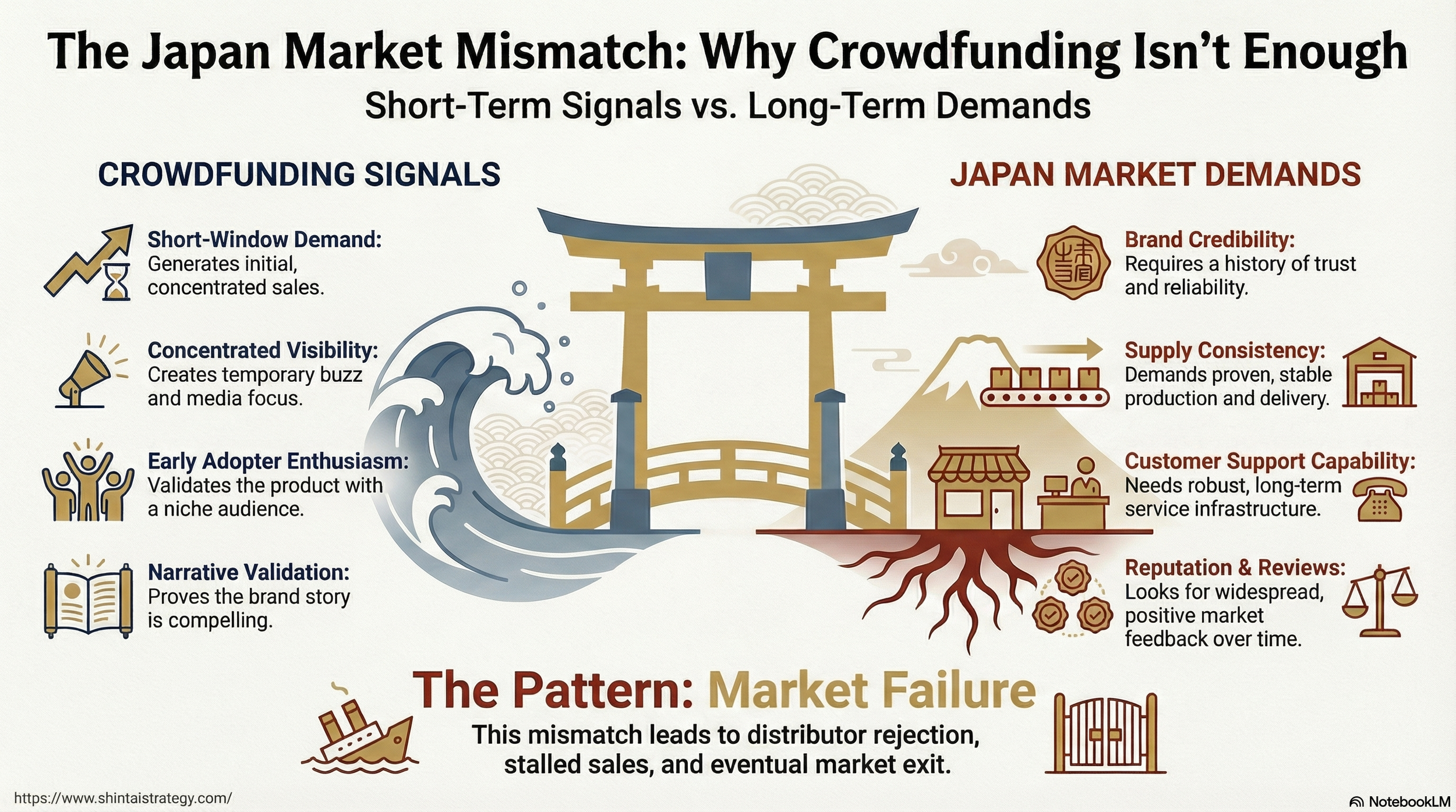
Why Crowdfunding Success Rarely Leads to True Market Entry
Japan’s market rewards a completely different set of signals than those produced by crowdfunding.
Long-term signals valued by Japanese partners
Brand credibility
Supply consistency
Customer support capability
Regulatory accuracy
Reputation and reviews
Channel transparency
Short-term signals produced by crowdfunding
Short-window demand
Concentrated visibility
Early adopter enthusiasm
Narrative validation
This mismatch explains the recurring pattern. Campaign success does not result in distributor adoption. Ecommerce sales do not continue after the launch. Operational strain undermines brand reputation. Brands eventually exit the market.
When Crowdfunding Is Actually Effective
Crowdfunding is most valuable under specific conditions.
Testing whether the product story resonates in Japan
Validating price sensitivity and willingness to pay
Building an initial group of early supporters
Collecting real demand signals before committing resources
Launching products that require strong narrative or visual explanation
Executing campaigns only when fulfillment capability is already stable
Crowdfunding is not recommended when positioning is unclear, regulations are unresolved, supply chain reliability is uncertain or the goal is simply to impress a distributor. Distributors do not evaluate brands based on crowdfunding revenue. They evaluate risk, reliability and long-term potential.
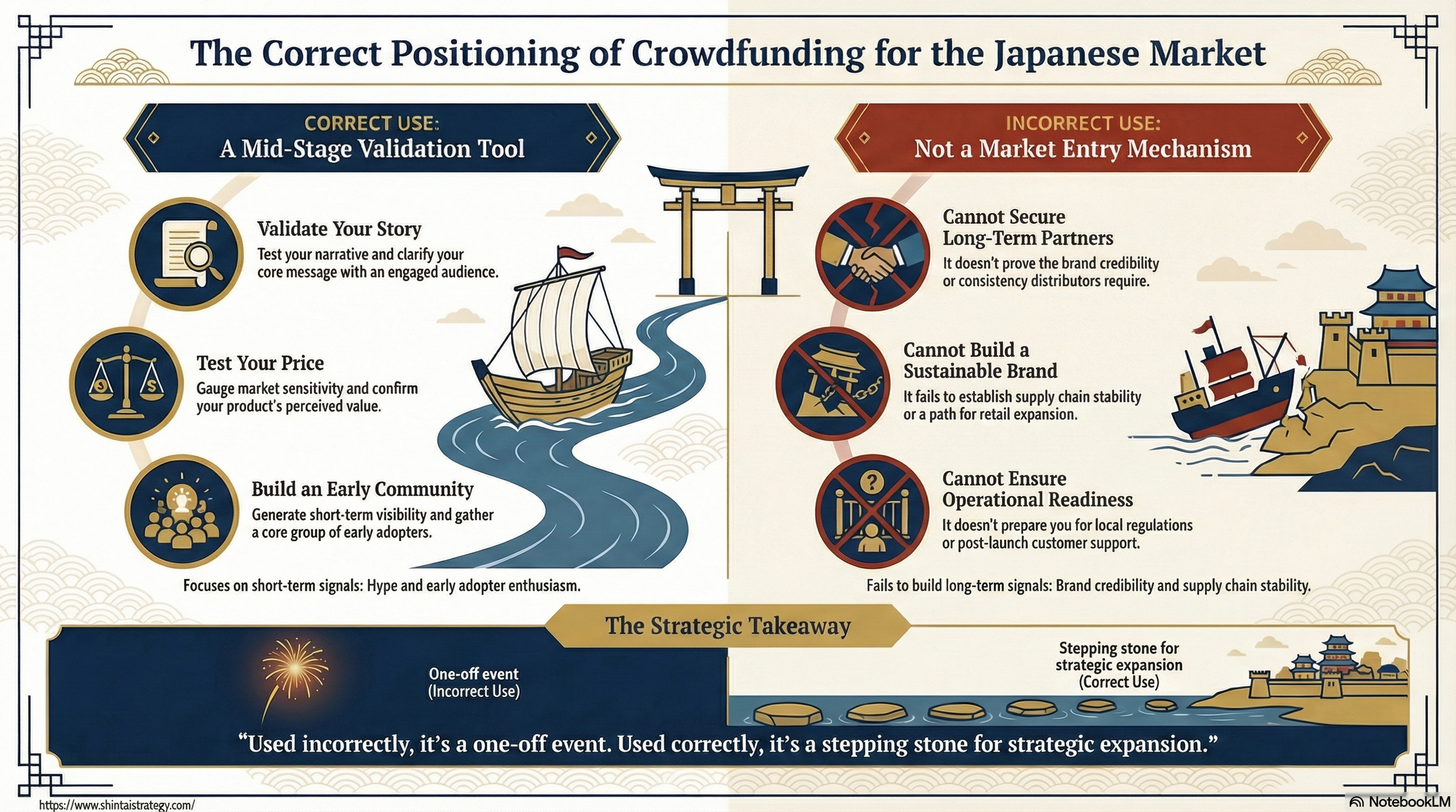
The Correct Positioning of Crowdfunding
A Mid-Stage Validation Tool, Not a Market Entry Mechanism
Crowdfunding can achieve
Story validation
Price testing
Message clarity
Short-term visibility
Community formation
Press coverage
Crowdfunding cannot achieve
Long-term brand building
Retail expansion
Regulatory readiness
Distributor commitment
Supply chain stability
Post-launch operations in Japan
Used incorrectly, crowdfunding becomes a one-off event. Used correctly, it becomes a stepping stone for strategic expansion.
Practical Feedback From Global Creators Confirms the Challenges
International brands consistently report:
Crowdfunding in Japan is more complex than expected
Platforms require brands to generate their own traffic
Post-campaign capabilities among small agencies vary significantly
Category performance differs widely
Platform and agency fees reduce pricing flexibility
Trust issues arise from inconsistent campaign quality
The collective message is clear. Crowdfunding is not a shortcut into Japan. It is a demanding project that requires preparation and follow-through.
A More Effective Approach
Pre-Launch Validation Combined With Post-Entry Acceleration
Crowdfunding generates high-value data including
Purchase behavior
Narrative resonance
Customer profiles
Category fit
Pricing response
When combined with structured market research, these insights become a powerful evidence package for distributor discussions. This is far more persuasive than sales figures alone.
A multi-phase crowdfunding strategy strengthens market readiness
Launching a first campaign before entering Japan and additional campaigns after entry can steadily grow brand recognition, expand online visibility and form a loyal fan base.
Japan’s strong social proof bias amplifies cumulative visibility
Consumers frequently respond to high engagement, high supporter counts, media exposure and multiple successful campaigns. Sustained visibility matters more than one large campaign.
The structural issue of one-off agencies
Some Japan-based agencies execute only the crowdfunding stage and do not support brands afterward. This often results in lost momentum, channel gaps and weakened trust among overseas manufacturers. Brands must evaluate partner capability beyond the campaign itself.
Conclusion
Crowdfunding has value in Japan because it offers
Low-risk validation
Speed
Real purchase data
Clear demand signals
It is not
A market entry strategy
A brand-building mechanism
A distribution solution
Leaders who understand the Japanese market ask
What can crowdfunding validate for us
Are we prepared for post-campaign operations
Do we have the capabilities to sustain presence
Crowdfunding is not a shortcut. It is a strategic checkpoint. Placed correctly, it reduces risk and increases the probability of long-term success in Japan.